What is the cement of memory?
Does what we remember form who we are?
Why do we forget 99% of our lives?
As I type this opening
paragraph, my brain is switching between thoughts about choosing interesting
words that will entertain itself as it compiles this sentence and—
switch—scrounging thru my memory-attic for events, which can fit in a bright mauve
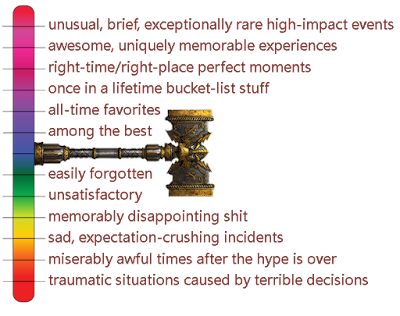
container labelled ‘
overwhelming’. My as-I-type brain just
decided that the first event to go in, is
Witnessing—for almost two full minutes—the
2017 total eclipse of the sun. I prepared for this event for months. I bought expensive wrap-around viewing glasses and a phone-app to track
where the shadow was going to be. Weeks before, I drove a few hundred
miles to reconnoiter. I read articles describing what to look for when
it happened. The day of, I woke at 4am for a 5am departure in order to
set-up three hours ahead of time. As the moon began to creep across the
sun, I recalled aloud (for the handful of people with me) a few previous
partial eclipses and used the term
underwhelming to describe those
curled and faded polaroid snapshots.—
switch—These vague recollections of pinholes in paper and flimsy cardboard glasses
are now attached—like a deflated balloon static-stuck to the back of a
worn-out child’s sweater—to the overwhelming event. (I typed
‘overshadowing event’ and edited it so as to not end this paragraph on a
pun.)—
switch—

The moment when the entire moon’s
shadow—
the umbra—completely covered the sun: the blue sky turned
black; the yellow corona around the sun became white; stars were visible; the
air temperature dropped; the silence of no-more bird and insect noises grabbed
for my attention; spots of corona-sunlight, inside of darker shadows, took-on
the changing shape (circular to crescent) of the umbra; and ripples of light
wavered across the ground like faint “light snakes.” My senses were
overloaded. I could not catch up. There was no time to think or
focus on the moment.
—
switch—It seems my as-I-type brain considers it's desirable when it-itself is
unable to function as it's currently functioning (which, it considers to be
its norm; its steady-state; its comfortable, uneventful, default mode; its
regular state of being, which is
neither over- or under-whelmed) and this asItype brain is not putting anything into
its memory. Short-term memory disappears unless something over- or
under-whelms enough to get stored long-term.
I know if I were not currently writing
about thoughts—an act which facilitates asItype to be able, in the future, to
become asIread (which, in turn, will become the me that has re-remembered
based on what previous-me wrote)—I would, very soon, no longer be able to
recall how I occupied myself this mid-November Friday morning. If I'd
instead been studying, reading, hiking, gaming, painting, listening to music,
watching videos, talking with friends, playing with my cat, or performing
routine chores, I would (probably) not be able to answer the question, “
What did you do last Friday morning?” Because of these words, these paragraphs, this essay (about normally
neither being over- or under-whelmed) I can say I was writing an essay about
memory.
Now asItype wonders why are our
recollections valued? Is being able to recall something because it was
sufficiently overwhelming/underwhelming to become immediately-permanently
locked in long-term memory a prerequisite to being consciously aware of what
is important to who we are and who we want to be? And—
switch—let me dig for a stronger, more recent, memory to stick in the intense
yellow
underwhelming container (next to those partial eclipses).
Last June, I drove the west-east
Going-To-The-Sun Road, through Glacier National Park. I would not use
the word
boring to describe the slow procession up and over—but I would
not use the word
exciting either. Rivulets of snow melt soaked me
a few times (cabriolet top was down) and some of the hairpin turns with sheer
drops revealed very interesting views; but a complete lack of wildlife and
over 90 minutes of traffic-jams combined to make the 50-mile drive an
unsatisfactory experience.—
switch—
Why?—my asItype-self
asks itself. What made this memorably underwhelming?
Preconceived
expectations were not met—during my first visit to Glacier National Park (13
years ago) the Going-To-The-Sun Road was closed because of snow (which
created—in that 2006-me’s brain—an unfulfilled desire). On that trip, I
felt privileged-lucky to see: bald eagle, elk, black bears and grizzly
bears, and experienced no vehicle traffic or full parking lots.

 Fickle icicle – grow n’ shrink